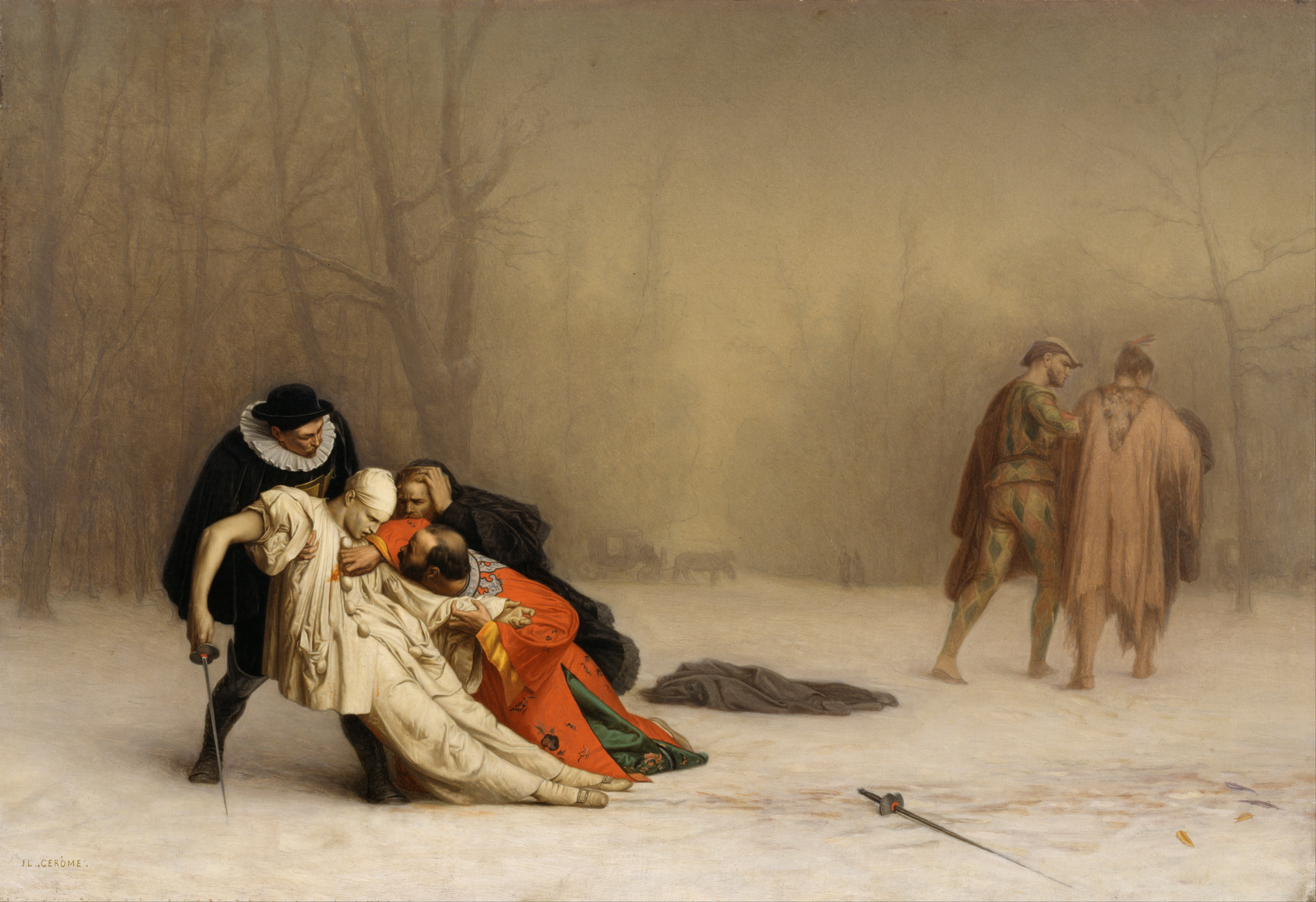
This painting is titled The Duel After the Masquerade created by the French artist Jean-Léon Gérôme around 1857-1859, and is a personal favourite
This will be covering a lot of the novel so if you do not want this work of a genius to be spoiled please refrain from reading this until you have done so. If you have already read, or not planning to read the book, please do carry on. I hope to have been able to pull some of my thoughts together in an easily followable manner.
I wrote this whilst listening to the whirling sounds of snowstorms and wind (on YouTube!).
Frankenstein was subtitled “The Modern Prometheus”, so it is worth adding before we start what this means. Prometheus was a titan from Greek Mythology, and he stole fire from the Gods and gave it to humanity. He defied Zeus’s orders by stealing fire from Mt Olympus. Fire transformed humanity, and was one of the first steps in creating what we have before us today. As punishment for his actions Zeus chained Prometheus to a rock and ordered ravens to gnaw at his skin to eat his liver. The liver would then regenerate and the ravens return everyday and Prometheus would receive this fate for eternity. In the context of Frankenstein what this represents is how a protagonist seeks forbidden knowledge only allowed for God(s), and then uses that to change the world. As Adam and Eve did when they ate from the tree of good and evil, in Frankenstein’s case he took the leap of animating a living-being. The novel explores this and what the consequences are for the human soul and humanity as a whole.
I will not be using any AI in this, or in any of my articles, this is a rather relevant topic to the novel of Frankenstein. It is maybe the new “modern Prometheus”? AI is a destroyer of the human relationship with the arts, although it can help in positive ways elsewhere, but in the arts I have a deep concern and sadness for it. In writing alone, it can take the beauty away from the majestic art of writing beautiful works and poetry, compare the works of Tolkien compared to AI output, for instance. This is beauty that can only be created from the golden centre of the human soul. As you read this, maybe consider, with our technological advancement going at such a pace, are we creating the new Frankenstein’s monster? I won’t be exploring this any further in my writing, just worth noting.
I read Frankenstein quite a while ago now, I believe about 9 months to a year ago, so please excuse a bit of a fuzziness around the detail. From a different perspective I see this is quite a more profound way to look back and see what parts and messages still stick out for me today.
First of all I will set the scene of why this story is so prevalent to me. When my Mum was watching the original Frankenstein movie with the great Boris Karloff, I decided that it was high time for me to enter the world. My Mum went into labour with me as this movie was on. I will also add, hopefully not ominously that there was thunder and lighting at the time. So to finally pick it up (far too long) was a sheer joy, and I certainly mark it as one of the greatest books I have ever read. All kudos goes to the ever-so-amazing Mary Shelley, who wrote this just a few miles away from me, in the City of Bath, in 1818. You can stand on the site where she wrote her masterpiece, just outside the Pump Rooms in Bath (near the Roman Baths); it is a marvel to stand on the spot where she wrote her novella.
The first thing that struck me (like a lightening bolt, aptly) was how easy it was to read and follow. This novel can be picked up by anyone, or can be easily followed in audiobook format. It really surprised me how this was the case considering it was written over 200-years ago.
I could write many points of reflection from this great novel, maybe in the fullness of time I will add more here, but I will keep this writing to my primary thoughts.
When Frankenstein (the maker, not the monster) was studying alchemical chemistry it seemed like he was possessed by it, in a trance of some kind, he didn’t step back and consider where he was going with this thoughts and ideas. He was diving in deep, into a realm of metaphysics, he wanted to create a living and breathing being. When reading this I felt that he wanted to be God and he did not consider the consequences of warping the metaphysical realm. He aspired to replace the role of God, to create his own perfect being, as God did when he created Adam and Eve. He was blinded to the consequences of his actions, but yet he continued in his possession to create his utopic ideal. He was in a sense turned off to his inner conscience. The voice that we all find deep within us that always asks where we are going and where we have strayed off the path of being good, was not breaking through for Frankenstein. Maybe purposefully he was avoiding this reality, maybe like we do with past trauma; we would rather avoid bringing things up to the surface to protect ourselves. We come up with behaviours / thinking patterns that stop these thoughts rising to the surface. As Carl Jung said we are not actually masters of our own house. Frankenstein was seized by his ambition to create his own being, it had power over him. Consider Frankenstein being a boat, and his ambition being the sea, was it the boat that is in control or was it the sea?
Frankenstein also had a strong sense of pride, he wanted to show the world that he is the perfect moulder of the clay, this was his utopic ideal. Pride is one of the deadly sins for a reason, as it can land you in a lot of trouble. As a bit of a sidenote, this great novel helps me to share why my account is named THRONE OF THORNS, when people, in their pride, try to reach (and sometimes succeed) in getting to the ‘top’, ‘the throne’, it is a thorny one, one which hurts the soul of the person, as well as for others. It turns people acidic and nasty, and a never-ending seeking of more power (just like the Ring, in Tolkien’s Lord of the Rings).
All of this comes together when Frankenstein finally creates his ‘perfect being’ (what I often call his ‘utopic ideal’, which makes it more relatable to what is happening today). When the monster arises, and Frankenstein first casts eyes on his creation, he succumbs to absolute terror and horror “Now that I had finished, the beauty of the dream vanished, and breathless horror and disgust filled my heart”. The monster is grotesque and chases after his maker. Frankenstein in realising what he has done, falls into deep sickness and goes into a coma. Henceforward, he lives in a state of terror of what he has created and what he has befell into the world. His, what I call, possession to create the perfect being in the end became his curse and the destroyer of his life, person-by-person, brick-by-brick. When I read this part of the book, I reflected a lot on the ‘metaphysical’, and how when we try to change the fine-tuned nature of the universe, be that on earth or closer to the stars, we are challenging the natural order of things. We need to be careful that we do not end up creating something grotesque (the majesty of the universe is, I believe, beyond what we can comprehend. So we better be careful when we bring new things into being). This is the realisation that Frankenstein arrived at when he created his monster.
Frankenstein’s monster was created using parts of the undead, like their brains and hearts, he was made as human-like as possible. He was over 8 feet tall, wide, and looked grotesque to the observer, everyone who set eyes on him ran away in fear. Upon being created and seeing how his creator reacted, he ran away to a hovel next door to a family (the De Lacey’s) which he, overtime, came to love from afar. In the night he would collect berries and food, and firewood and leave it at their door. He cared for them deeply from observing afar for many years; his heart and soul was filled with love and care, for the first time he had a sense of belonging, a connection. He steadily built up his courage to go and see the father (who was blind) whilst the others were out. They had a pleasant and warm conversation and the father wanted to introduce him to his family. When they arrived they were disgusted by what they saw, and they hit and cursed the monster, and he ran away with a deep pain in his heart. The monster felt that he was part of the family, and he felt betrayed by them. This started his rage and resentment of humanity, and he was now plotting his revenge on his maker. This, once a feeling of love, now turned to betrayal caused such a powerful distress emotion in the monster. It highlighted the power of betrayal and resentment, and a lust for revenge. In Dante’s Inferno, Dante depicts the levels of hell going down to Lucifer, and the bottom of hell before the door to Lucifers chamber is is that of the betrayers. One of the reasons I think Dante sets this at the bottom was because he saw the resulting impact of betrayal. The monster represents this perfectly, he was betrayed by a trusting relationship (albeit, felt alone by the monster) which lead to resentment and a lust for revenge.
Interestingly, I found the monster to be a deep thinker. He read many great books, most notably Paradise Lost (which I finished recently and will be writing about). This story, in a very small nutshell, is the story of Lucifer, whom through seeking his own power disobeyed God and he fell from heaven to reign dominion over hell. Lucifer then seeks to take ownership over the earth realm, and to take revenge on God by poisoning the souls of his human creation The monster is now seeking his own revenge on Frankenstein, and upon humanity. I have no doubt there are reasons why Mary put this into her novel, maybe what I have arrived at is the case, or for other reasons which I have not yet been able to find.
When I finished the book, it seemed to me that the novel did a full circle. It started with a diary entry of a ship heading north which got trapped in the ice, and the crew saw a person on a sleigh with a big figure approaching from behind. The crew rescued an exhausted person, and the big figure disappeared. At the end of the novel, I came to realise that the person who they saved was Frankenstein. The crew looked after him as he edged closer to death. During the cover of nightfall the monster came aboard and spoke with his maker as he passed away. They spoke about Frankenstein’s wish of the monsters demise, and the monster said that he would, rather than seeking revenge on humanity, take his own life (to be consumed by flames). He had a desire for oblivion and release from his suffering that was caused by his creator. The monster then leaps onto a raft and disappears into the distance.
Very central to the novel are themes of revenge, resentment, trauma, and the pride to replace God as the maker of the human soul, as Lucifer did in Paradise Lost. Maybe the monster saw what God did in creating man, and saw God as if he was his own maker, and understood why Lucifer rebelled against him. As I have mentioned above, it is interesting how reading Paradise Lost coordinated with his growing lust for revenge.
I felt that in the end the Monster ended his trauma, and the potential trauma that would have been bestowed on humanity. He took his suffering and the impact that he would have on the world away, he sacrificed himself for the good of humanity which I found really interesting. Even though these dark powers were in him, he decided to take himself out of the equation; to rebalance the metaphysical. It feels as though there was a goodness in him to come to that decision. This is something I have not yet come to understand, how did he who was grotesque and made as a result of prideful intentions, still have a flickering light within him. That is a dichotomy that is beyond my comprehension at this stage. At the end of the novel it is not clear whether the monster did in fact sacrifice himself, so that question is left open. Do we trust him at his word, or is he deceiving, for that we will not ever know.
“I shall ascend my funeral pile triumphantly, and exult in the agony of the torturing flames”
Leave a Reply