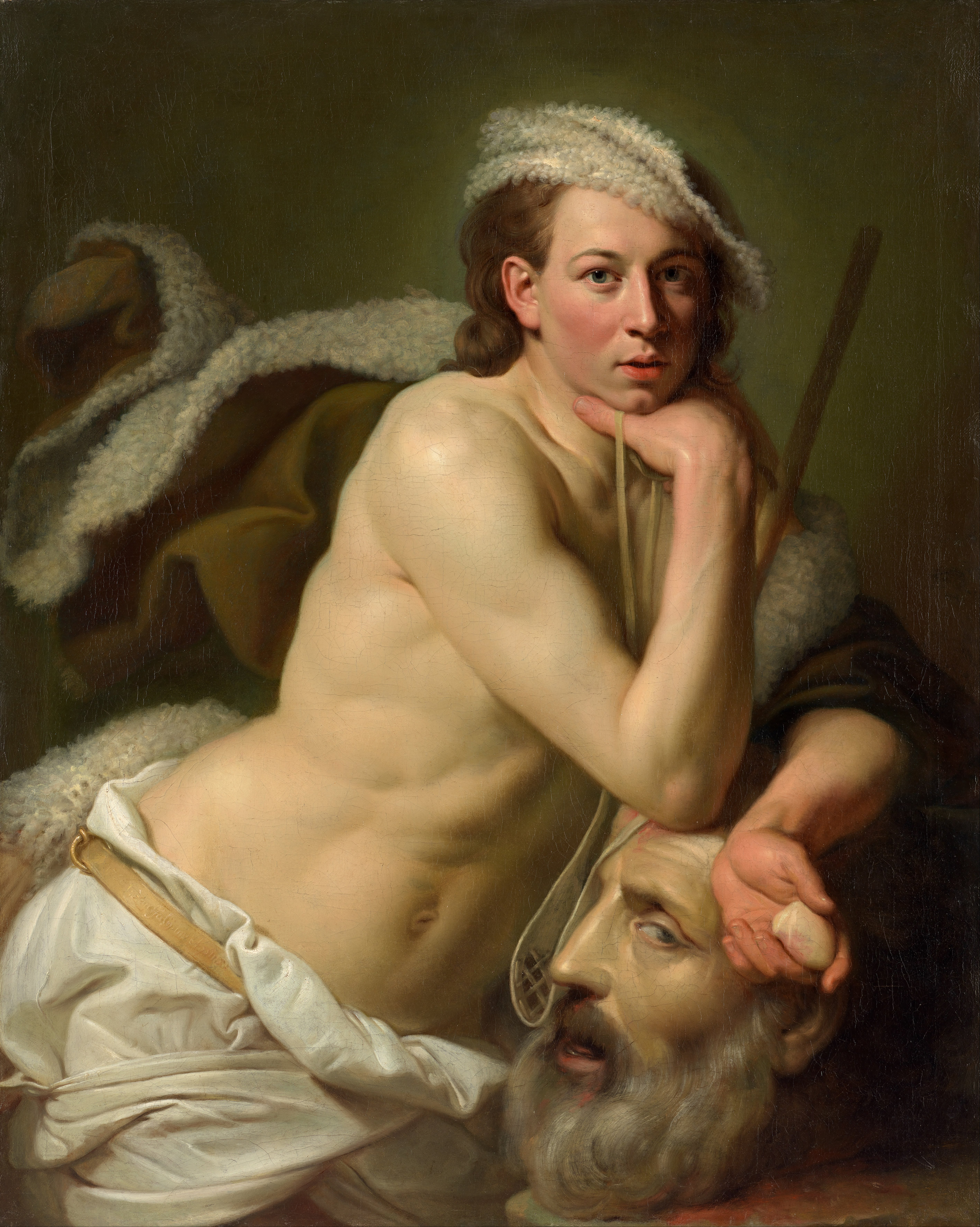

Johan Zoffany, “David with the Head of Goliath” 1756
Also known as Johannes Josephus Zaufallij(y) / Johann Zoffany / John Zoffany
I have pleasure in introducing you to Johan Zoffany’s , “David with the Head of Goliath”, My eyes first caught sight of this wonder upon the wall of my dear friend Lus Lips at co ordinates of 10435 Loxodrom, and I immediately fell in love. When I returned home, I began to research the marvellous Johan and the tale of David and Goliath as narrated in the Old Testament, Book of Samuel. Johan is a marvellous fellow with a very intriguing story, I give reference to the movie “Mr Turner” , and specifically the extras , and you will understand. Due to the nature of this brief article, I shall provide a concise probe into the life of Johan, the novel of David and Goliath and a personal analysis of his painting “David with the Head of Goliath” 1756.
Dear Olde’ Johan was born March 1733 in Frankfurt-am-Main, Germany. He was the son of an Architect and was bought up under Prince Alexander Ferdinand of Prussia. Apprenticed by a local painter, Martin Speer, after completing his apprenticeship , he visited Rome in 1750, where he studied alongside portrait painter Masucci and found the acquaintance of Piranesi. One thing to note, is that his painting “David with the Head of Goliath” was produced relatively early on in his career whilst he was in Rome. Zoffany arrived in England around the time of 1760, due to his poor English he worked with clock-master Stephen Rimbault, painting scenes for clock-faces. Following this he worked with Benjamin Wilson, who specialised in portrait work as a drapery painter. His career boomed when he met with the famous actor David Garrick, of whom became Zoffany’s first patron, he was commissioned to paint 4 paintings for his household in 1762. Zoffany also painted a number of theatrical pieces that attracted the attention of the public, and Queen Charlotte who fell in love with his work..
Zoffany’s first English exhibit was at the “Society of Artists” between 1762-69, he was granted membership to the Royal Academy of Arts (RA) by George III in 1769, where he exhibited his work for 30 years between 1770 – 1800. During the dates of 1772-78, he worked primarily in Florence, where he painted some of his most famous paintings, including The Interior of the Tribuna at Florence , as part of the Royal Collection. He returned to London in 1779, following his time at Florence he fell out with the King and Queen over the Tribuna, resulting in his visit to India between 1783-89. By 1809 referencing an account from Kathryn Cave in the Diary of Joseph Farrington IX, “Zoffany’s faculties were gone. He had become childish”. Zoffany died at his home on 11 November 1810.
I used – http://www.tate.org.uk/art/artists/johan-zoffany-620 for reference here
I shall now provide a very brief outline of this famous tale, similarly to Judith Beheading Holofernes it is written in the spirit of the “Oppressed overcoming the Oppressor” …. Saul (the first king of a United Kingdom of Israel and Judah)and the Israelite’s were facing the Philistines at the valley of Elah. On the occasion of twice a day for 40 days, the champion of the Philistines, Goliath challenged the Israelite’s to send out a champion for a duel. Saul and the Israelite’s were afraid of Goliath, David bringing food for his older brothers,(he was not a soldier just a young boy who tended his sheep) had heard that Goliath defied the armies of God, David valorously accepted the fight. Saul after accepting the request of David, offered him his armour, however David declined, taking just his staff, sword and his slingshot with 5 stones from the river bank of the Elah , he confronted Goliath.
Goliath, with his decorated golden armour , and David with his staff, sword and slingshot, commenced with chatter …
“The Philistine cursed David by his gods”, David replied: “This day the LORD will deliver you into my hand, and I will strike you down; and I will give the dead bodies of the host of the Philistines this day to the birds of the air and to the wild beasts of the earth; that all the earth may know that there is a God in Israel, and that all this assembly may know that God saves not with sword and spear; for the battle is God’s, and he will give you into our hand.”
David equipped his slingshot, and fires a stone with all his strength and hits Goliath in the middle of his forehead. Goliath fell to the ground head first, and David cut off his head. The Philistines routed the battlefield, and were chased down by the Israelite’s . David took the head of Goliath to Jerusalem, and earned hero status for his victory across all the land.
Now onto, “The lovable artist who ate a sailor”, Johan Zoffany’s painting of himself as “David with the Head of Goliath” (1756), the painting currently lives at the National Gallery of Victoria. In Zoffany’s representation of David , there is still an ongoing debate whether David is in fact a portrait of Zoffany himself or not, the consensus is that this is the case, so I shall investigate on this premise.
Zoffany has defined himself as a youthful, strong/ athletic and healthy being, symbolised by his pale fresh skin, rosy cheeks, long hair and hearty features. His pose is solid, with his right arm purposely poised on his chin, as if deep in thought. Whilst his left arm lays upon the head of Goliath, as if resting on a table. His left hand is very feminine and soft, indicating openness with his grasp of the stone that killed Goliath, whilst his right hand is strong and firm.
In respect to the body language (open, or closed) and psychology of the Israelite’s newest hero, I personally think Zoffany’s painting provides an accurate representation of David. Reflecting back to the story, David was a simple man, he looked after his sheep , tended the land. After his triumph over Goliath, he was thrown into the light as a hero of the Israelite’s, of course he is proud of what he did to save his people, but this would shock him and cause anxiety. David would therefore exude some confidence, however his very nature as a man who kept himself to himself, he would thus reflect a defensive pose in protecting himself. Zoffany has portrayed an intelligently balanced analysis (based on the observations made above) of what he would be like when with his trophy. What’s your views?
Whenever I look at paintings , the very first thing I look at are the hands, and the question I ask is, whether they are soft, more feminine, a calming demeanour or if they are strong and purposeful, masculine if you will. Interestingly in the self portrait, it is a mixture of both, which leads me to think that Zoffany is portraying himself deep in thought, in reflection. This could well be, one, what he thinks David would be like after he defeated Goliath with his trophy , or maybe it is a representation of Zoffany’s thinking as a person at the time.
You can see the slingshot hanging from David’s right hand (thumb specifically), and the staff resting on his left arm , as referenced in the story. The sling shot rests upon the right eye of Goliath’s face, and his head lies upon a flat rock with the dulcet tonnes of blood. The bearded giant’s head is profile, and his left eye looks directly at us, as if alive and in control of his body, which brings an interesting element to the painting.
With many paintings of David and Goliath, the head of Goliath’s is very large in comparison to Davids, to intensify the golf of size between the two (for example Claude Vignon’s, David with the Head of Goliath 1620-23 (see at bottom of page)). In Zoffany’s depiction Goliath’s head is not represented as large as some other paintings, maybe Zoffany wanted to remove the excessive size difference in order to not belittle David or even himself. I think this is a much more realistic representation of the story, although he is larger it is not an unrealistic representation. This painting provides a much more realistic rendition of the David and Goliath story. Both David and Goliath make direct eye contact with the viewer, which makes the painting ever more difficult to take your eyes away from it.
Zoffany’s work demonstrates marvellous softness and delicacy with the tonnes of his pale, youthful skin to the velvety look upon the face of Goliath. I also see something so wonderful about this painting, that I have yet to read of. I would like to bring to your attention, the arrow shape of David’s right arm to the direct point of Goliath’s fatal wound at the centre of his forehead. When you see this , it is so obvious yet it is manifested in the softest way possible. Notice also, the strap directly piercing through the arrow head, as if it is the shaft of the arrow. It is remarkable, once you see this, your eyes always tend to be drawn directly to it. This is magical, because outside of this triangle, the lines are so curved, and poetic. Also to note if you draw a line from the middle of David’s face, down the thread of his slingshot you land directly to Goliath’s critical wound. I imagine if you see behind this painting you would see many measured lines, that bring a delightful foundation to this beautiful masterpiece. The shaft also extrapolates the arrow shape as I have mentioned, directly drawing attention to Goliath’s head.
The colours are also delightfully soft, Zoffany used greens, browns and greys for the basis of his palette. To mention, a traditional colour background, an angelic white colour of David’s under robe, a Golden belt (Zoffany, if you notice added his signature to the belt, providing further support that David is a self portrait) and the natural green to his wool coat. In analysis, the colours very much pose the essence of David’s life, a life on the land, with greens, browns and sheep whites. Works perfectly with the context of the story and in beautiful balance with the soft skins tonnes of both David and Goliath.
I shall end my investigation here, I could go on and on I must say. There are so many more elements to discuss with this painting, of which I am likely to explore at a future date. One thing you may wish to investigate is that ongoing discussion of the phallic nature of the slingshot and the stone. This is a big study and would warrant further research from me. When I research such ongoing discussions in the field, it provides a much greater underlying purpose of this wonderful painting by Zoffany. I wanted to keep this as brief as I could so I shall not explore further, you can expect a fuller account in the near future.
Thank you so much for reading this synopsis, delving into the story of David and Goliath, learning about the wonderful Johan Zoffany and of course my analysis of one of the great masterpieces. Good day , and till next time. Regards, Ollie
———————————————————————-
Claude Vignon , David with the Head of Goliath (1620-23)

Caravaggio , David with the Head of Goliath (1610)

Guido Reni , David with the Head of Goliath (1620-23)

Leave a Reply