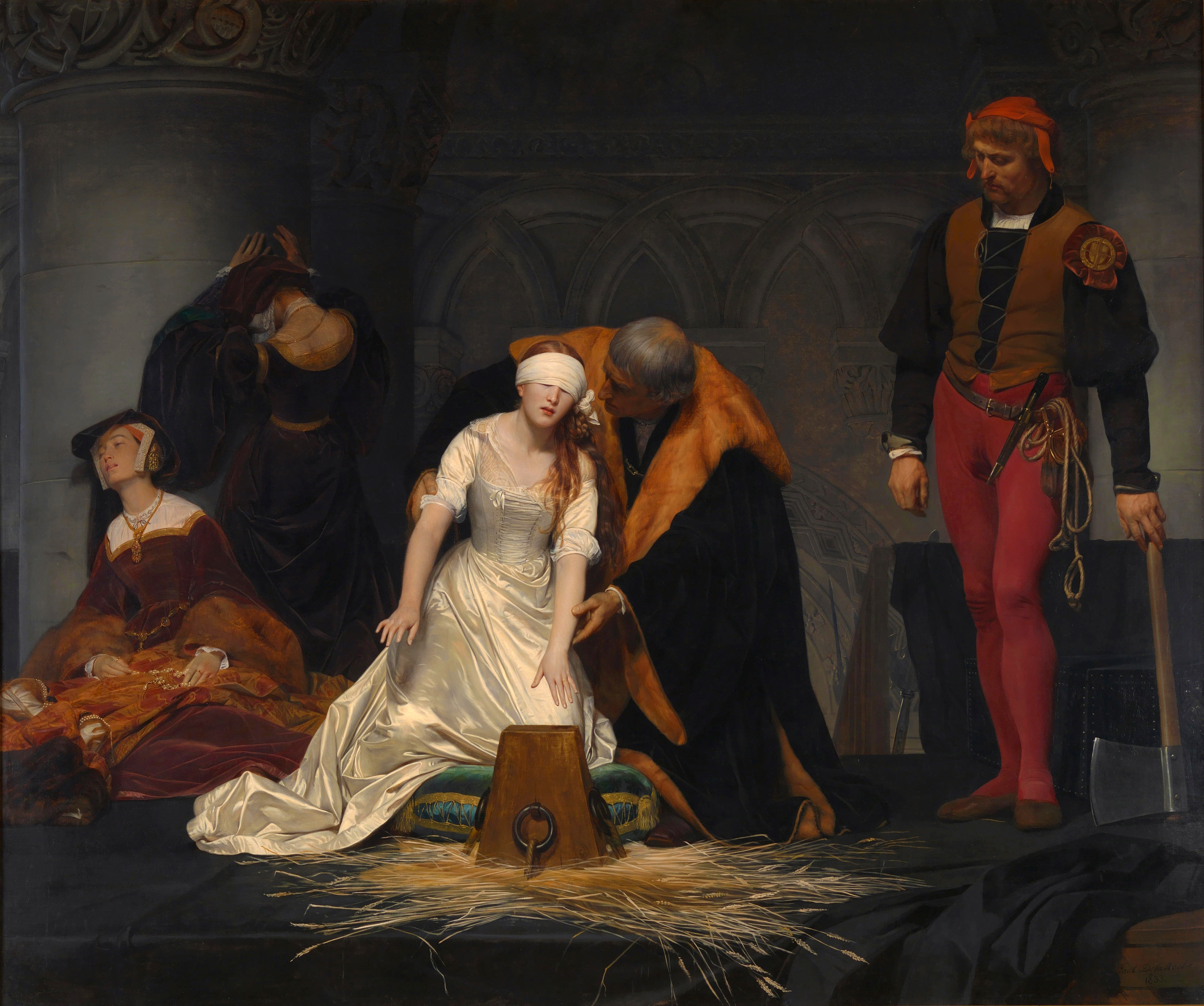
The Execution of Lady Jane Grey, 1833, Paul Delaroche (Painting located at the bottom of the page – would recommend casting your delightful eyes over it before reading my commentary)
This evening I with great pleasure present you with one of my favourite and most important paintings from my collection, “The Execution of Lady Jane Grey” by Paul Delaroche.
I shall begin with an introduction to the artist, then I will look at the historical background of the painting . Following this I will present you with what the painting means to me and why it is of great importance.
Paul Delaroch (17 July 1797 – 4 November 1856) was a French Painter who specialised in painting life sized Historical subjects, often of a tragic nature with very close attention to the finer details. He also painted portraits and religious studies. Delaroche was born in Paris where he was trained by Claude-Henri Watelet and the famous historical painter Antoine-Jean Gros.
He first exhibited his work at the Louvre Salon Carre in 1822. “The Execution of Lady Jane Grey” was presented 12 years later (1834) and was enthusiastically received . Delaroche continued to pursue the theme of large historical paintings… Throughout his life time his work received wide international acclaim.
His subjects were painted with a soft , firm and smooth finish, this texture was commonplace for its time, such examples of other artists include Jean Auguste Dominique Ingres and Louis Leopold Robert.
Before we begin to look deeper at the painting it is very useful to look at the historical context of the Lady Jane Grey story.
Lady Jane was born in 1537 and executed in February 1554 at the tender age of 17, she was most remembered as the Nine Day Queen. Lady Jane’s father was Henry Grey (Duke of Suffolk) and her mother was Lady Frances Brandon , the daughter of Henry VIII’s sister Mary.
Lady Jane had a very strict upbringing and a poor relationship with her parents. However, she did have a wonderful friendship with Catherine Parr, Catherine held strong Protestant values and was an Academic. Lady Jane matured into an highly intelligent, devout lady.
Lady Jane soon became a ward of Baron Seymour of Sudeley, who attempted unsuccessfully to arrange a marriage between Lady Jane and Edward VI. Seymour was executed for treason in 1549. Following the death of Seymour, Lady Jane fell under the influence of John Dudley, (Duke of Northumberland). Dudley was the Chief Advisor to Edward VI. In 1553 a marriage was arranged between Lady Jane and Dudley’s son, Lord Guilford Dudley.
John Dudley successfully managed to persuade Edward VI to manipulate the order of succession so that Lady Jane would succeed to the Throne. Dudley’s argument was that Lady Jane was Church of England and Mary was Catholic, and any change back to Catholicism would be disastrous for England. His plan was that if Lady Jane (his daughter in law) was queen and his son king, he would have much greater influence over Royal Policy .
Edward VI died on July 6th 1553, Lady Jane succeeded the throne, the proclamation was read out on the 10th July 1553, her reign would only last nine days.
After this succession the people of England found a new love and appreciation for Mary Tudor. England had enjoyed decades of stability under the Tudors, and the name had become synonymous with England’s European standing. On July 19th Mary Tudor was announced as the Queen of England and Lady Jane was sent to the Tower of London. The rebellion convinced Mary that Lady Jane whilst she remains alive, would remain a threat to her. Mary also raised concerns that Lady Jane when given the chance would not convert to Catholicism.
Lady Jane along with her husband were beheaded on February 12th 1554, after being found guilty of treason. Guilford was executed first followed by Lady Jane. Before she was executed, Lady Jane said that she never wanted to be Queen of England and that she would die a true Christian Women. This is where we land a foot at the marvellous , haunting , beautiful painting by Paul Delaroche, how do you think he has represented this historical account? Please ponder as you continue to read my commentary
I have spent many an hour researching and reading about this wonderful painting by Delaroch, I must guide you to the following Youtube videos before I continue https://www.youtube.com/watch?v=wgwb5bln-Fw , https://www.youtube.com/watch?v=UiXlUh04ARI. The following succeeding commentary will outline many of the paintings Historical Controversy’s that define how accurate an historical portrayal Delaroche provides.
The subsequent examples provide an outline of some of the key controversy’s raised-
- The Execution of Lady Jane Grey according to Historians who have reviewed written accounts from the event, say that the Execution took place factually in the Courtyard outside of the London Tower , rather than in the dungeon depicted in this painting.
- Directing you towards the Executioner on the right side of the painting, he seems rather out of place, his garments seem more French/ Italian inspired rather than an Executioner by trade walking the cobbled paths of London, England. I believe it to be the case that Delaroche did not visit the shores of England, so his perception of what an English Executioner would wear would not be an accurate one.
Looking online , I have read numerous points of view and many come to a consensus that, Delaroche gravitated to constructing dramatic effect rather than historical truth, I, intervening here, from my point of view believe that part of the beauty of the Artists tool kit is to visualise and execute their own depiction of Historical or Religious events. Others would argue that an accurate , truthful representation is most important, both views are equally accepted…. What is your view?
It is important to mention in respect to the central shot of Lady Jane at the Executioners block, the blindfold upon her face is historically accurate and has been regarded as truth in many written accounts of the Execution..
One thing to consider is how difficult it would have been for Artists of the 18/19th Century to obtain actual written accounts, this on top of cultural perceptions make it very difficult to provide an accurate profile of the true events. More specifically analysing the Executioners attire, the fact that Delaroche did not visit England, made it very difficult to culturally and through lack of first hand observation provide an accurate representation of the English way of life.
The Following will present you with what my senses speak when I look deep into this painting, what the painting means to me and why it is of great importance. This will show you the light it brings to my love of the Arts, and why I look at it every day upon my wall with open heart and soul… Master O Paul Delaroche!
Delaroche in this painting builds an intensely close, personal affair, for me I feel as though I am in the very dungeon , the sense of dread , the taste of damp dungeon walls and sounds of screams. When I look at this painting, I imagine the sounds of despair of the ladies on the left , and the chilling silence of Lady Jane and the Executioner, with the sinister whispers of the fellow guiding Lady Jane to lay her face in readiness for Execution. Her beautiful ‘rosey’ cheeks make it so beautiful and delicate , which leads the viewer into a false sense of security and warmth. A somber element of the painting I find most haunting is where Lady Jane is reaching to feel for the block where she will lay her face for the fall of the Axe. One of the questions this painting raises for me, is about Death, something we must all participate in … when I view this painting I reflect on this subject.
My thinking, is that Delaroche wanted a mechanism to pull all the key characters into one shot, and the dungeon helped him to cultivate this ambition. This makes the painting busy and chaotic in order to breed an intense viewing, to represent despair, pain and melancholy … Though interestingly according to historical reports she proudly and with great pride walked to her death .
Now on to why this painting is of great importance to me …. This painting has always intrigued me, evoked so many thoughts and feelings .. enticed the senses, although tragic I see it as a painting of reflection of myself . The most profound , important element for me is the blindfold upon Lady Jane’s face.. Through this I reflected and asked the question of myself, do I wear a blindfold ? , and yes I do.. we all do. Imprisoned by our own thoughts, ways of thinking, worries and anxieties. With this painting I use the metaphor of Lady Jane Grey as a tool to remove my blind fold from my eyes , to open them wide ……
When I walk my paths , I hope that I represent a person that walks without a blindfold , one that looks forward, side-ways and behind not simply straight forward. Therefore to remove the blindfold is a metaphor to open my mind to everything, to care for all I meet with all the love and support I can give, and to be open to all forms of thought with an open heart. To accept difference and to love it…. To care deeply for my fellow human being and to do all I can to bring happiness and joy. The greatest feeling in the world for me , is making people happy through kind true words, or gifts that come from my heart , these smiles are more important that you can ever imagine. When I make you smile , I smile twice as much. AND This Painting represents this, and when I look at this despite the context, it represents this beautiful enlightenment I am so lucky to see… out of darkness I see Light, out of Light I see Darkness !!!!!!!!
Thank you very much for reading my thoughts on this marvellous, thought provoking painting by Paul Delaroche, in “The Execution of Lady Jane Grey” .. I include below for interest an actual account of Lady Jane’s execution alongside her husband’s…. Please feel free to leave your comments, or message me via Facebook, or Instagram. With Love and Kindest Regards, Ollie
Account – Unknown Author
His (Guilford’s) carcass thrown into a cart, and his face in a cloth, he was brought to the chapel within the Tower, where Lady Jane, whose lodging was in Partidge’s house, did see his dead carcass taken out of the cart, as well as she did see him before alive on going to his death – a sight to her no less than death. By this time was there a scaffold made upon the green over against the White Tower, for the said Lady Jane to die upon……The said lady, being nothing abashed…with a book in her hand whereon she prayed all the way till she came to the said scaffold….First, when she mounted the said scaffold she said to the people standing thereabout: “Good people, I am come hither to die, and by a law I am condemned to the same. The fact, indeed, against the queen’s highness was unlawful, and the consenting thereunto by me: but touching the procurement and desire thereof by me or on my behalf, I do wash my hands thereof in innocency, before God, and the face of you, good Christian people this day.” and therewith she wrung her hands, in which she had her book. And kneeling down she turned to Fackenham (the dean of St Paul’s) saying “Shall I say this psalm?” And he said “Yea”. Then she said the psalm of Misere mei Deus in English, in most devout manner, to the end. Then she stood up and gave Mistress Tinney her gloves and handkerchief, and her book to Master Bruges, the lieutenant’s brother; forthwith, she untied her gown. The hangman went to her to help her therewith; then she desired him to let her alone, and also with her other attire and neckerchief, giving to her a fair handkerchief to knit about her eyes.Then the hangman kneeled down, and asked her forgiveness, whom she gave most willingly. Then he willed her to stand upon the straw: which doing she saw the block. Then she said “I pray you dispatch me quickly.” Then she kneeled down saying “Will you take it off before I lay me down?” and the hangman answered her “No, madam”. She tied the neckerchief about her eyes: then feeling for the block she said “What shall I do? Where is it?” One of the standers-by guiding her thereto, she laid her face down upon the block, and stretched forth her body and said “Lord, into thy hands I commend my spirit.” And so she ended.
http://www.historylearningsite.co.uk/tudor-england/lady-jane-grey/
References / Points of Interest –
http://www.historylearningsite.co.uk/tudor-england/lady-jane-grey/
http://www.bbc.co.uk/history/historic_figures/grey_lady_jane.shtml

Leave a Reply